Dude. Doting husband. Pastor @ FCCSouth Lafayette, IN. Trying to be emergent, transformative, radical, and altogether a more faithful Jesus-follower.
Tuesday, July 16, 2013
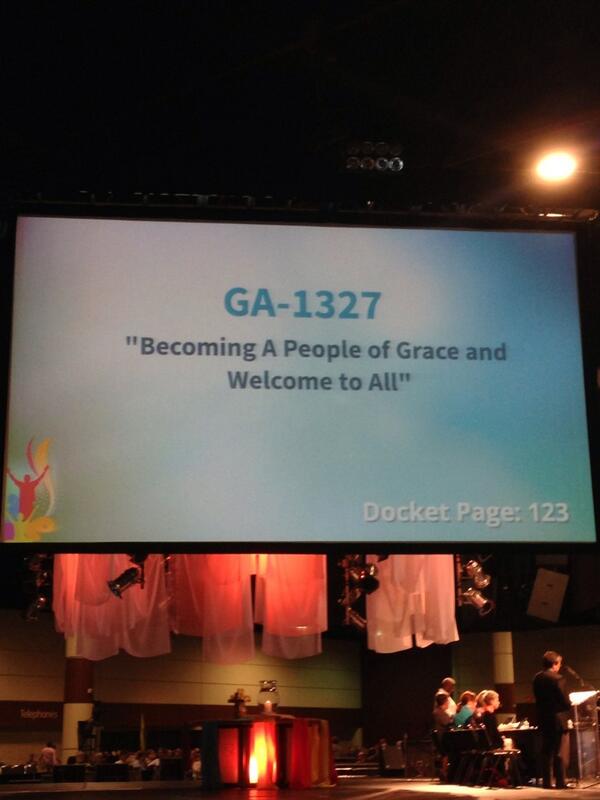
A People of Grace and Welcome to All
This is what's happening in Orlando right now. As I write this, the debate is raging - well, has been raging; I believe they've stopped right this minute for some parliamentary procedure of some kind.
As I write this, Disciples of Christ from churches and institutions throughout the global breadth of our denomination are discerning, debating, and deciding. Their decisions on various topics - from resolutions condemning unfair wage practices or drone warfare, to resolutions supporting the DOJ's promised investigation of the Trayvon Martin incident, to this resolution on grace and welcome - are not binding upon congregations. Nobody will be kicked out of the Disciples of Christ for disagreeing with a decision of the Assembly, and nobody will be forced to comply with a practice that they don't want.
But these resolutions are important nonetheless.
Because Christians are meant to speak for and with those in pain. We are meant to recognize the ways that we - our society, ourselves, and even (especially!) our churches - hurt other people, deny the fact that they are fully human beings made fully in the image of God.
It would be easy to consider this debate in terms of how it affects me, how it affects my congregation, how it affects our image.
But those aren't the most important factors.
It would be easy to consider this debate in terms of a church simply following the rules laid out by God, denouncing evil and celebrating good.
But those are simplistically misleading answers to complex emotional questions, and the fact is--
God is not about rules. Just plain not. If God's highest goal were humanity following the rules set out in the Holy Books, then God would never have given us Jesus Christ. Christ proved by his
life
words
love
death
resurrection
that the God who sent him is best recognized by an all-consuming love for Its creation. An all-pervasive grace that overcomes all obstacles and draws all people to one another, to Christ, to the Source.
That's the only reason I'm a Christian. That's the only reason that I know this God. That's the only reason that I am confident in the future - because God loves, and doesn't stop loving, any and all of the people It created.
As I write this?
As I write this, I learn that the Assembly has passed the resolution, and my eyes fill with tears of praise.
Thank you, Lord, for guiding Your children in the ways of love.
Thank you, Lady, for nurturing our compassion and helping it to grow.
Thank you, Eternal Companion, for never leaving our sides.
Thank you, Friend of the Friendless, for opening our eyes to the people that You have called us to serve.
Disciples, you are not required anything but what your heart tells you, but... Disciples, you are called by name to
welcome
accept
affirm
and love
without ceasing
without restrictions
without barriers
Just love. That's what we are called to do. That's what we've agreed to do.
It is resolved. Let us be so resolved, and act like God's children.
Monday, July 8, 2013
Great Quote from JPII
I ran across this beautiful quote today from the beloved, late, soon-to-be-Saint, John Paul II:
Amen!
It is Jesus who stirs in you the desire to do something great with your lives, the will to follow an ideal, the refusal to allow yourselves to be ground down by mediocrity, the courage to commit yourselves humbly and patiently to improving yourselves and society, making the world more human and more fraternal.”
Amen!
Wednesday, July 3, 2013
No, It's Okay, I'm Not Racist! I Get It!
#1 - It's apparently tough for me to keep up a regular blogging schedule. Oops. Working on it.
#2 - I've been thinking lately about race.
Ethnicity. Heritage. History. Color. Whiteness. Blackness. Otherness.
I feel like it's important to discuss these things, to see where we stand on them, and to see the ways we can stop doing damage and start doing good. As a follower of Christ, it's important to, like him and the God he communicates, embrace those considered "other", to find our commonality as humans and as children of God.
I think about it often, the "race problem". Sometimes, it's because of something overt I've seen out in the world - On Facebook or Twitter, on a bumper sticker, spewing from the mouth of some Christian personality on television. Sometimes it's because I've come across some well-meaning but still racist ideology in one of those venues - somebody complaining about racism against white people, or denouncing the existence of discrete black culture as divisive, or denying the inherent racial biases within such social ills as poverty, crime, and drug abuse. Just recently, I saw again the blanket claim that racism is no longer an issue in America. That we are a post-racial society. That we are all color-blind, and that we as a society punish those who see race and judge upon it.
But racism is so not dead that it's the status quo. Every time you see a brainiac of Asian descent on TV, that's a little bit of racial prejudice poking through. Every time you see Jeff Dunham pull out his "Ahmed the Dead Terrorist" puppet, that's pure mockery of people with Arabian heritage, and people who hold the Muslim faith. Every time you see a poor kid of African descent sacrificed upon the altar of white American values, from the Treyvon Martin debacle to every black man who receives a harsher sentence than his white counterpart for a minor drug conviction, you are seeing the powerful and harmful effect that racism has on our neighbors of color.
Every time the world screams that racism is dead - because of MLK Jr., or Obama, or "my black friend", or Kanye West - that's racism at its most cruel and insidious.
You may notice that I'm using really awkward language. As if the Hyphenated-American language wasn't clunky enough, right? Now we have to say things like "of African descent", "with Arabian heritage", etc.
As a young man at my college once called out during a racial-sensitivity-seminar, "I'm just being honest -- if I see somebody who's black, I'm going to call them black!"
Is that an individual being racist? Do you have to use a slur to be racist?
Do you, personally, even have to feel negatively about other races to participate in racism?
When it comes down to it, racism isn't about individuals saying or doing stupid discriminatory things. Those actions are important and horrible, of course, but they're mostly a red herring.
Racism is about the million, billion subtle ways that our
language
behavior
newsmedia
entertainment
institutions
systems
perpetuate harmful myths about nonwhite people, and dismiss their real human experiences, sweeping people under the rugs of their ethnicities.
It's calling a person black, when her name is Susan.
It's thinking a person is smart because of their east-Asian heritage, when his talents and abilities grow and fluctuate over time as they are nurtured and abandoned, just like yours.
It's staring in wide-eyed-wonder as a brown-skinned person prays fervently, assuming that their ethnic spirituality is deeper than your white neighbors' glassy-eyed trudge down the communion line on Sunday, when people of all colors and heritages are flawed, distractable, and pious in their own ways.
It's when we white folks try to speak on behalf of our sisters and brothers of color, denying them the chance to share their own stories, their own experiences, using their own words in their own time. Even when we're "standing up for them", even when we're shouting, "No! It's okay! I get it! I'm not one of those racist white people!", we still reduce our neighbors to nothing more than archetypes.
You are not Susan, you are A Black Woman. I, the Enlightened White Man, will speak for you and fix your plight, in an attempt to purge my own guilt about how my ancestors kidnapped, beat, imprisoned and oppressed your ancestors.
In short, when we reduce a person to their color, or the geographic region where their family originated, we hurt that person. When we consider a person to be black before we consider her to be human, we hurt all humanity. When we hear somebody speak Spanish, and immediately imagine that the person is rich, poor, smart, stupid, evil, devout, lazy, or hardworking, then we hurt God, who creates all people as complete, complex, many-sided reflections of God's complex, many-sided Self.
#2 - I've been thinking lately about race.
Ethnicity. Heritage. History. Color. Whiteness. Blackness. Otherness.
I feel like it's important to discuss these things, to see where we stand on them, and to see the ways we can stop doing damage and start doing good. As a follower of Christ, it's important to, like him and the God he communicates, embrace those considered "other", to find our commonality as humans and as children of God.
I think about it often, the "race problem". Sometimes, it's because of something overt I've seen out in the world - On Facebook or Twitter, on a bumper sticker, spewing from the mouth of some Christian personality on television. Sometimes it's because I've come across some well-meaning but still racist ideology in one of those venues - somebody complaining about racism against white people, or denouncing the existence of discrete black culture as divisive, or denying the inherent racial biases within such social ills as poverty, crime, and drug abuse. Just recently, I saw again the blanket claim that racism is no longer an issue in America. That we are a post-racial society. That we are all color-blind, and that we as a society punish those who see race and judge upon it.
But racism is so not dead that it's the status quo. Every time you see a brainiac of Asian descent on TV, that's a little bit of racial prejudice poking through. Every time you see Jeff Dunham pull out his "Ahmed the Dead Terrorist" puppet, that's pure mockery of people with Arabian heritage, and people who hold the Muslim faith. Every time you see a poor kid of African descent sacrificed upon the altar of white American values, from the Treyvon Martin debacle to every black man who receives a harsher sentence than his white counterpart for a minor drug conviction, you are seeing the powerful and harmful effect that racism has on our neighbors of color.
Every time the world screams that racism is dead - because of MLK Jr., or Obama, or "my black friend", or Kanye West - that's racism at its most cruel and insidious.
You may notice that I'm using really awkward language. As if the Hyphenated-American language wasn't clunky enough, right? Now we have to say things like "of African descent", "with Arabian heritage", etc.
As a young man at my college once called out during a racial-sensitivity-seminar, "I'm just being honest -- if I see somebody who's black, I'm going to call them black!"
Is that an individual being racist? Do you have to use a slur to be racist?
Do you, personally, even have to feel negatively about other races to participate in racism?
When it comes down to it, racism isn't about individuals saying or doing stupid discriminatory things. Those actions are important and horrible, of course, but they're mostly a red herring.
Racism is about the million, billion subtle ways that our
language
behavior
newsmedia
entertainment
institutions
systems
perpetuate harmful myths about nonwhite people, and dismiss their real human experiences, sweeping people under the rugs of their ethnicities.
It's calling a person black, when her name is Susan.
It's thinking a person is smart because of their east-Asian heritage, when his talents and abilities grow and fluctuate over time as they are nurtured and abandoned, just like yours.
It's staring in wide-eyed-wonder as a brown-skinned person prays fervently, assuming that their ethnic spirituality is deeper than your white neighbors' glassy-eyed trudge down the communion line on Sunday, when people of all colors and heritages are flawed, distractable, and pious in their own ways.
It's when we white folks try to speak on behalf of our sisters and brothers of color, denying them the chance to share their own stories, their own experiences, using their own words in their own time. Even when we're "standing up for them", even when we're shouting, "No! It's okay! I get it! I'm not one of those racist white people!", we still reduce our neighbors to nothing more than archetypes.
You are not Susan, you are A Black Woman. I, the Enlightened White Man, will speak for you and fix your plight, in an attempt to purge my own guilt about how my ancestors kidnapped, beat, imprisoned and oppressed your ancestors.
In short, when we reduce a person to their color, or the geographic region where their family originated, we hurt that person. When we consider a person to be black before we consider her to be human, we hurt all humanity. When we hear somebody speak Spanish, and immediately imagine that the person is rich, poor, smart, stupid, evil, devout, lazy, or hardworking, then we hurt God, who creates all people as complete, complex, many-sided reflections of God's complex, many-sided Self.
Tuesday, April 30, 2013
Outer-Space Outlaws?

One of the pictures above depicts an illegal alien. Can you guess which one?
Whenever I hear the phrase, "illegal alien", that's all I can think of: "What do you mean, like an outer-space outlaw"?
Part of the problem is our use of the word "alien". The internet says that the standard modern use of the term - referring to an extraterrestrial - is traceable back to 1864. In our post-X-Files world, whenever you say "alien", the first thing that comes to most people's minds is a little green man.
Part of the problem is our use of the world, "illegal". As is often said, people cannot be legal or illegal. People can commit crimes. People can have or not have proper documentation to be in a place. But people can't be illegal.
So when we put these words together - "illegal alien" - we get this notion of an inherently polluted nonhuman creature. A beast so incapable of civility that its very nature is law-breaking. Sadistic, unsympathetic, and unworthy of human decency.
That's why it's so easy to say things like this:
However.
Consider this loving God that we proclaim and we serve.
Consider the words of the prophets and the patriarchs -- "The foreigner residing among you must be treated as your native-born. Love them as yourself, for you were foreigners in Egypt." (Lev 19:34) This is not an isolated command, but a running theme, and nowhere is there any mention of legal immigration status.
Consider the call throughout Scripture to care for and defend the people most powerless in society (the Scripture often explicitly referencing immigrants) - and who, in our society, is more powerless than people who have no protection from a legal system that will rip them from their lives and families to incarcerate or exile them if they speak up?
Consider grace, that quality of God that causes God to love each and every one of us despite the ways that we hurt, that we defile, that we destroy.
Consider love, that quality of God that causes God to do and wish the best for each of us no matter what we deserve.
Consider grace, that quality of God that causes God to love each and every one of us despite the ways that we hurt, that we defile, that we destroy.
Consider love, that quality of God that causes God to do and wish the best for each of us no matter what we deserve.
Consider what the Kingdom of God - the Domain of God, the Reign of God, the Family of God - really is. It's a version of our world in which there is no "us" or "them'. It's a vision of our world in which all nations are the human nation and all families are the human family. It's a glimpse of our world in which people are treated in human terms as equally as they are loved in God's heart, and where "justice roll[s] down like waters, righteousness like an ever-flowing stream."
Poverty is a problem for all people. Injustice is a problem for all people. And the national/moral barriers that we put up between people and people, people and resources, people and God? Those barriers are as false as the barrier between Jew and Gentile, slave and free, male and female...
This is not about who deserves to eat and drink and have shelter, because every human being deserves those things. This is not about who gets a slender slice of the meager pie, because there is abundance both in God and in America. This it not about who got where first, or who has the right papers and who doesn't, and it's not even truly about the law - because, "the fruit of the Spirit is love, joy, peace, forbearance, kindness, goodness, faithfulness, gentleness, and self-control. Against such things there is no law." (Gal 5:22-23)
In Christ, and in the beloved community that Christ is creating among us, nobody is illegal, nobody is undeserving, and nobody is an alien. We are all beloved children of God.
Saturday, April 27, 2013
Commitments, Covenants and Church Members
I've been thinking a lot lately about membership.
It's long been a running joke in churches that membership is a made-up number.
There are many churches, and many dedicated staff members, who put excellent and thorough work into calculating church membership. But things happen - people accumulate on the rolls but fade out over time. People are transient - they move, they change careers or sides of town or groups of friends, and people fade away. More often, "active membership" is a fluid term - is somebody active if they come to worship once every six weeks and a small group five weeks out of every six months? And what about all those people who clearly have a relationship with a church, but who never came forward during the altar call and answered The Big Question in front of God'n'everybody? What about all those people who fall between the cracks of "visitor", "member", and "active member"?
That's life.
So here's the question - what do we do about church membership? Because it's clearly built around a model that's no longer realistic, especially in cities. We can't expect people to establish a church home and stay there for their whole lives, and we certainly can't guilt people for living their real lives out there in the world instead of in church every day. Furthermore, research is clear that Millenials - the new adult generation formed of people like me born in the 1980s and 1990s - aren't joiners. They don't join - they do and they serve, if they believe in the cause, but they don't join. How passe!
Aren't we equipping people to live as Jesus-followers out there in the world?
Furthermore, all the traditional "benefits" of membership - exclusive communion, barrier to church leadership, social stigma - are failing. In our church, anybody can and does take part in leading worship. Any and all people are invited to take part in the Sacred Feast of Christ. We recognize the value of engaging with people where they are, even if they only show up to church every couple of months.
By the same token, we can't abolish membership. More to the point, we can't ignore commitment. We can't ignore the fact that people will inevitably respond to the Gospel, from time to time, with the fervent desire to dedicate their lives to what has for centuries been called The Way. That's a sacred covenant, with great responsibilities for both individual and body.
Becoming a Christian has nothing to do with baptism. It has nothing to do with church membership, youth group, or lifting your arms in worship. It has everything to do with a commitment to a love-oriented way of life. That's a very hard thing to dedicate yourself to - and when somebody decides to take that identity onto themselves, we should celebrate their bravery and strength with all due pomp and circumstance. Baptism and other commitment rituals are crucial. We need to recognize commitment... without pretending that "church members" are a separate and better class of people.
However membership ends up "looking" at FCC SouthSide, I know this -- our easy labels telling us "who's in the club" are gone. All we have are people - people dedicated, people wavering, people unsure, people trying, people succeeding and failing, people helping one another on the journey to God's wholeness and peace. If we can recognize the power of each moment on that journey, celebrate the difficult decision to walk, and walk with people as they take each trepidatious step, we will all reach the Kingdom together.
Share your thoughts on this complicated and deeply-rooted subject below, on Twitter with @revgeiger, or on Facebook with PastorGeiger. Thanks, and may your day bring you all the blessings you seek and more.
It's long been a running joke in churches that membership is a made-up number.
There are many churches, and many dedicated staff members, who put excellent and thorough work into calculating church membership. But things happen - people accumulate on the rolls but fade out over time. People are transient - they move, they change careers or sides of town or groups of friends, and people fade away. More often, "active membership" is a fluid term - is somebody active if they come to worship once every six weeks and a small group five weeks out of every six months? And what about all those people who clearly have a relationship with a church, but who never came forward during the altar call and answered The Big Question in front of God'n'everybody? What about all those people who fall between the cracks of "visitor", "member", and "active member"?
That's life.
So here's the question - what do we do about church membership? Because it's clearly built around a model that's no longer realistic, especially in cities. We can't expect people to establish a church home and stay there for their whole lives, and we certainly can't guilt people for living their real lives out there in the world instead of in church every day. Furthermore, research is clear that Millenials - the new adult generation formed of people like me born in the 1980s and 1990s - aren't joiners. They don't join - they do and they serve, if they believe in the cause, but they don't join. How passe!
Aren't we equipping people to live as Jesus-followers out there in the world?
Furthermore, all the traditional "benefits" of membership - exclusive communion, barrier to church leadership, social stigma - are failing. In our church, anybody can and does take part in leading worship. Any and all people are invited to take part in the Sacred Feast of Christ. We recognize the value of engaging with people where they are, even if they only show up to church every couple of months.
By the same token, we can't abolish membership. More to the point, we can't ignore commitment. We can't ignore the fact that people will inevitably respond to the Gospel, from time to time, with the fervent desire to dedicate their lives to what has for centuries been called The Way. That's a sacred covenant, with great responsibilities for both individual and body.
Becoming a Christian has nothing to do with baptism. It has nothing to do with church membership, youth group, or lifting your arms in worship. It has everything to do with a commitment to a love-oriented way of life. That's a very hard thing to dedicate yourself to - and when somebody decides to take that identity onto themselves, we should celebrate their bravery and strength with all due pomp and circumstance. Baptism and other commitment rituals are crucial. We need to recognize commitment... without pretending that "church members" are a separate and better class of people.
However membership ends up "looking" at FCC SouthSide, I know this -- our easy labels telling us "who's in the club" are gone. All we have are people - people dedicated, people wavering, people unsure, people trying, people succeeding and failing, people helping one another on the journey to God's wholeness and peace. If we can recognize the power of each moment on that journey, celebrate the difficult decision to walk, and walk with people as they take each trepidatious step, we will all reach the Kingdom together.
Share your thoughts on this complicated and deeply-rooted subject below, on Twitter with @revgeiger, or on Facebook with PastorGeiger. Thanks, and may your day bring you all the blessings you seek and more.
Saturday, April 6, 2013
Madness and Prayer
Hey folks!
It's been pointed out to me that I never gave a final update on the outcome of Lent Madness through this blog when it ended last week.
So, if you're itching to get up-to-date, here it is:
After a hard-fought Faithful Four and final matchup against St. Luke the Evangelist...
Frances Perkins has won the Golden Halo! Apparently Christendom has a soft spot for social justice workers and "firsts" - as she was the first woman in the US Cabinet, and is responsible for all sorts of social reforms on everything from child labor laws to establishing a minimum wage to creating Social Security.
Congrats Madam Secretary!
---
I also wanted to take a moment to share with you a new take on the Lord's Prayer that is a rather fitting for this venue and this modern age:
"A Blogger's Prayer" by Andrew Jones
Our Father
who lives above and beyond the dimension of
the internet
Give us this day a life worth blogging,
The access to words and images that express
our journey with passion and integrity,
And a secure connection to publish your daily
mercies.
Your Kingdom come into new spaces today,
As we make known your mysteries,
Posting by posting,
Blog by blog.
Give this day,
The same ability to those less privileged,
Whose lives speak louder than ours,
Whose sacrifice is greater,
Whose stories will last longer.
Forgive us our sins,
For blog-rolling strangers and pretending they
are friends,
For counting unique visitors but not noticing
unique people,
For delighting in the thousands of hits but
ignoring the ONE who returns,
For luring viewers but sending them away
empty handed,
For updating daily but repenting weekly.
As we forgive those who trespass on our sites to
appropriate our thoughts without reference,
Our images without approval,
Our ideas without linking back to us.
Lead us not into the temptation to sell out our
congregation,
To see people as links and not as lives,
To make our blogs look better than our actual
story.
But deliver us from the evil of pimping ourselves
instead of pointing to you,
From turning our guests into consumers of
someone else's products,
From infatuation over the toys of technology,
From idolatry over techology
From fame before our time has come.
For Yours is the power to guide the destinies
behind the web logs,
To bring hurting people into the sanctuaries of
our sites,
To give us the stickiness to follow you, no
matter who is watching or reading.
Yours is the glory that makes people second
look our sites and our lives,
Yours is the heavy ambience,
For ever and ever,
Amen
It's been pointed out to me that I never gave a final update on the outcome of Lent Madness through this blog when it ended last week.
So, if you're itching to get up-to-date, here it is:
After a hard-fought Faithful Four and final matchup against St. Luke the Evangelist...
Congrats Madam Secretary!
---
I also wanted to take a moment to share with you a new take on the Lord's Prayer that is a rather fitting for this venue and this modern age:
"A Blogger's Prayer" by Andrew Jones
Our Father
who lives above and beyond the dimension of
the internet
Give us this day a life worth blogging,
The access to words and images that express
our journey with passion and integrity,
And a secure connection to publish your daily
mercies.
Your Kingdom come into new spaces today,
As we make known your mysteries,
Posting by posting,
Blog by blog.
Give this day,
The same ability to those less privileged,
Whose lives speak louder than ours,
Whose sacrifice is greater,
Whose stories will last longer.
Forgive us our sins,
For blog-rolling strangers and pretending they
are friends,
For counting unique visitors but not noticing
unique people,
For delighting in the thousands of hits but
ignoring the ONE who returns,
For luring viewers but sending them away
empty handed,
For updating daily but repenting weekly.
As we forgive those who trespass on our sites to
appropriate our thoughts without reference,
Our images without approval,
Our ideas without linking back to us.
Lead us not into the temptation to sell out our
congregation,
To see people as links and not as lives,
To make our blogs look better than our actual
story.
But deliver us from the evil of pimping ourselves
instead of pointing to you,
From turning our guests into consumers of
someone else's products,
From infatuation over the toys of technology,
From idolatry over techology
From fame before our time has come.
For Yours is the power to guide the destinies
behind the web logs,
To bring hurting people into the sanctuaries of
our sites,
To give us the stickiness to follow you, no
matter who is watching or reading.
Yours is the glory that makes people second
look our sites and our lives,
Yours is the heavy ambience,
For ever and ever,
Amen
Wednesday, March 27, 2013
Enter the Champion [Sermon from Palm Sunday]
You know, Lent has always been a
kind of a downer. It’s sorta designed that way, isn’t it? I mean, it’s a period
of repentance and mourning, not happy stuff. It starts out on Ash Wednesday,
which is a whole service built around reminding us of the reality of death.
Then we go through the entire month, giving something up or fasting or adding
on more spiritual disciplines – if you’re observing Lent, it’s tough. Sundays
are a relief, since technically Lent takes a break on Sunday and you can do
whatever, but it’s still not a happy time. In fact, an ancient tradition holds
that we’re supposed to “Bury the Alleluia” during Lent – we’re supposed to put
away the word Alleluia (literally, singing praise to the Lord), and not speak
it again until Easter. Some congregations even do this physically, making some
object that represents the Alleluia and burying it in the ground until Easter.
It’s not a celebratory time, Lent.
But then you get Palm Sunday, a
party within the dark journey. In case you’re not familiar with Palm Sunday –
which we celebrate today in the church calendar - let me give you the basic
rundown: After Jesus is more or less finished with his teaching ministry, it’s
almost time for the Festival of Passover. Jesus, with thousands of other devout
Jewish people in that part of the world, makes the pilgrimage to the Holy City
of Jerusalem for the festival. Outside the city, he has two of his followers
borrow a donkey from in town, and he rides the donkey to the Temple. As he’s
coming, crowds start gathering. They recognize this guy. They know who he is,
what he’s done, and they have an idea of what he’s doing now. They get excited.
They greeted him on the road, waving branches and shouting and singing:
“Hosanna to the Son of David” (“Hosanna” literally means “Save us”, but it’s a
much more joyful word than it sounds, and it almost became sort of a catchall
praise-word) - “Save us, Son of David!
Blessed is the one who comes in the name of the Lord! Hosanna in the highest
heaven!” In Matthew’s version, Jesus then goes on to start a ruckus at the
Temple with the moneychangers. In Luke’s version, Jesus goes from his donkey to
a hilltop where he weeps over the city. In Mark’s version, he and the disciples
go look at the Temple, but it’s late so they go back to the suburbs where their
rooms are. Some accounts are more dramatic than others.
But it’s exciting, you know? The
people are excited! These shouts of joy seem to come spontaneously, unprompted.
They see Jesus, they remember him, and they’re excited for what he’s doing.
They see God’s hand in all of this. In fact, when they see him, they remember
all sorts of words from the prophets – like Zechariah, who talked about the
King coming to the people riding humbly on a donkey, instead of a great
warhorse like most kings do – and they think “Yes! I recognize this! This is
what God does when God sends us a King!”
They’ve been wanting a King. Some
have been wanting a Messiah, the holy king anointed by God. Some have wanted
just, y’know, not the Roman Emperor, or King Herod who was a puppet of Rome and
wasn’t very good to his people. The people wanted a new, better, leader. As I
was studying for the sermon, I kept thinking of some lyrics from one of the
great hymns of my generation:
“Where have all the good men gone, and where are
all the gods?
Where’s the street-wise Hercules to fight the
rising odds?
I need a hero! I’m holding out for a hero til
the morning light.
He’s gotta be sure, and he’s gotta be soon,
And he’s gotta be fresh from the fight!”
Okay, that’s not from a hymn. If
you are my age or older, you know that’s the 1981 Bonnie Tyler song, “Holding
Out For a Hero”, best known as part of the soundtrack for Footloose.
[EDIT: I'm told by people much hipper than I that this song is now better known from its place in Shrek 2. If you say so, dear!]
But I’ll tell ya, it hits the nail
on the head, doesn’t it? Our songs and our poetry, they have a way of doing
that, of really landing right on these feelings.
In fact, our text for today has a
little something in common with that. We’re going to be reading from Psalm #118
today – many of the Psalms are in fact meant to be poetry or music, many of them
were originally songs, and that’s why many Jewish and Christian traditions
still sing them today. Psalm 118 isn’t a song, though – it’s a dramatic
performance. Psalm 118, the best scholars can figure, is what’s left of a
religious-slash-political ceremony, involving the King (or a priest playing the
part of “King”) coming into the city after a great battle. It's got more than one part, and it's meant to be performed responsively. Accounting for the limitations of this medium, however, you'll have to imagine the call-and-response. Or, y'know, grab a friend a perform the Psalm together!
This is the first piece of Psalm
#118, verses 1-4, adapted from the Common English Bible. The leader's words are in plain text and the people's responses are in bold text.
1 Give thanks to the Lord for God is good,
because God's faithful love lasts forever
2 Let Israel say it:
"God's faithful love lasts forever!"
3 Let the house of Aaron say it:
"God's faithful love lasts forever!"
4 Let those who honor the Lord say it:
"God's faithful love lasts forever!"
Amen! That was the simplest bit. We’ll come back to read a little more of Psalm 118 in a few minutes.
God’s faithful love lasts
forever! At that moment, at that time,
when the great teacher Jesus is making his way into Jerusalem, the people know about God’s faithful love. At that
moment, they understand that God is still with them, that they have not been
forgotten. In one way or another, the crowds thought, their champion had come.
We know what it’s like to root for a champion. To put your
trust and hope in somebody, to cast your support with somebody and push them
towards their prize. You know this feeling if you’ve ever supported somebody in
an election. If you’ve ever thrown your hat in behind a team or an
athlete.
Or a Lent Madness athlete. I know that some of you
have been following the Lent Madness contest, the unique Anglican devotional
that pits 32 saints against one another in online-voting-combat. Have any of
you picked favorites and followed them? Well I’m happy to say that one of my
favorites – one of the saints that I preached about a few weeks ago – has made
it to the semifinal round, the Faithful Four: Hilda of Whitby will be squaring
against Frances Perkins. Just to remind ourselves, Hilda of Whitby was a woman
in the 600s from the British Isles who founded an abbey and a whole new rule
for monastic living that upheld Celtic Christian practices instead of the more
dominant Roman Catholic ones. Frances Perkins, her opponent, was the US
Secretary of Labor under FDR, the first woman to be in the US Cabinet, and she
was responsible for a lot of the social justice programs that keep poor
Americans alive, like unemployment benefits, pension, child labor laws, minimum
wage and overtime laws. That was her way of living out the call to serve
humanity in love – she once said “I came to Washington to serve God, FDR, and
millions of forgotten, plain common workingmen.”
That’s Monday’s matchup. Tuesday brings us the bizarre
pairing of St Luke the Evangelist versus Oscar (o-SCAR) Romero. Luke, as you
might know, is the traditional author of the Gospel of Luke, traditionally
depicted as a physician and historian. Oscar Romero, on the other hand, was the
Archbishop of San Salvador in the 1970s, who used his position to speak out
against El Salvador’s government’s repression, its violation of people’s civil
rights, its violence against its own citizens. Eventually he was assassinated
by his government, while celebrating Mass, the day after he called for
Christians in the Salvadoran military to stop participating in the violence and
repression. He was shot as he lifted the cup to celebrate Communion. He’s
considered a martyr.
[NOTE: This was preached Sunday March 24. Today, March 27, brings us the winners of those matchups, and today is the final showdown between Frances Perkins and Luke the Evangelist!]
Make no mistake, these people are heroes. They are
champions. They changed the world. They showed us ways to love God and carry
out God’s mission. They showed us new ways to love the world and the people in
it – Frances Perkins and Oscar Romero, who worked to liberate people from the
injustice and oppression in the world, to lift people out of poverty and into
joy. They showed us new ways to understand our old stories – Hilda of Whitby,
who make Christianity make sense to Celtic pagans, and who showed people God in
a way that truly made sense to them, even if you and I would barely recognize
it. They showed us how God was working in the world – Luke the Evangelist, who
conducted countless interviews and collected countless stories of Jesus and his
followers, so that the world would have the most complete picture of Christ possible.
Our champions show us the best of
our past and the best hope for our future. They give us confidence in our victory – at
least, they give us confidence that we will not be defeated, that we will not
be overtaken and destroyed. For the Jewish people two-thousand, 2,500 years
ago? They had lots of great champions, from Samson (super-strength, long hair)
to Elijah (prophet, power of God at his fingertips, so awesome that he didn’t
even die but God whooshed him up to the sky in a chariot of fire), all the way
back to Moses (who faced Egypt and her armies in God’s mission to free the
Hebrews from slavery). But for these people, the #1 hero of their culture and
their stories was King David. Well, any King, really, but for them, every King
was a recasting of David, and David set the standard for every King. How many
leaders – presidents, monarchs, emperors – get people so hyped-up for them that
they’re the standard by which every other leader is judged for literally centuries?
David was a textbook champion – he
was the runt of his family, but he was chosen by God’s messenger. When he was
still a teenager or a young man he took out the opposing champion, Goliath,
with his slingshot. As the leader of Israel, he won battle after battle, taking
territory and strengthening the nation.
Heck, according to tradition,
David’s the one who wrote the Psalms! Now, it’s almost certainly not true, but
the Psalms do show us a lot of the people’s celebrations about the King, about
his protection and wisdom, about his special connection to God (the real leader
of the people), about his military victories.
When the people saw Jesus riding
into town, it’s no wonder that they thought of the words from the Psalms. Here
was Jesus, the humble yet wise and crafty teacher from Galilee, doing a
Triumphal Entry! Riding into town like a King returning from battle, and here
they come with the shouts of joy and praise. Here they come, waving the palm
branches and the laurels, the symbols of victory.
Read along with me the second part of the text (though you don’t have a speaking part in this one).
Psalm 118, verses 5-18, as the King tells the story of his battle and his
deliverance to the excited, gathered crowds.
5 In tight circumstances, I cried out to the Lord.
The Lord answered me with wide-open spaces.
6 The Lord is for me — I won’t be afraid.
What can anyone do to me?
7 The Lord is for me—as my helper.
I look in victory on those who hate me.
8 It’s far better to take refuge in the Lord
than to trust any human.
9 It’s far better to take refuge in the Lord
than to trust any human leader.
10 All the nations surrounded me,
but I cut them off in the Lord’s name.
11 Yes, they surrounded me on every single side,
but I cut them off in the Lord’s name.
12 They surrounded me like bees,
but they were extinguished like burning thorns.
I cut them off in the Lord’s name!
13 I was pushed so hard I nearly died,
but the Lord helped me.
14 The Lord was my strength and protection;
God was my saving help!
15 The sounds of joyful songs and deliverance
are heard in the tents of the righteous:
“The Lord’s strong hand is victorious!
16 The Lord’s strong hand is ready to strike!
The Lord’s strong hand is victorious!”
17 I won’t die—no, I will live
and declare what the Lord has done.
18 Yes, the Lord definitely disciplined me,
but God didn’t hand me over to death.
This is what they expect of Jesus.
They know that his battle isn’t fought yet, but it’s still what they expect – a
show of might! A little propaganda, if you please! It’s the only way they can
expect him to behave.
The big thing about champions is
that they show us the way out of our despair. They answer the great question
that is on our heart, show us the light at the end of whatever tunnel we’re
crossing. And for the people of Judea in the first century, the question on
their minds is, “How long do we have to suffer Rome? How long will the Emperor
declare himself our leader, and how long do we have to pay him tribute, have to
use money that says he’s a god, have to wait on pins and needles until he
decides to crack down on our religion again and decide that we all have to
worship him? It’s happened before; it’ll happen again. We need deliverance –
who will bring it? Whom will God send?”
And when Jesus comes a-riding into
town on that little donkey, they recognize it. They recognize him as the
champion that God has sent to free them, to give them independence and rebuild
the throne of David! Put yourself in their shoes – you can feel the excitement,
can’t you?
“Up where the mountains meet the heavens above;
Out where the lightning splits the sea;
I could swear that there’s someone somewhere
watching me.
Through the wind and the chill and the rain, and
the storm, and the flood,
I can feel his approach like a fire in my blood!
Okay, so that was Bonnie Tyler
again, but you feel it, right? Aren’t you ready?
They don’t know how he’s going to
do it, but Jesus is going to defeat the emperor. They don’t know how he’s going
to do it, but Jesus is going to remove Israel out from under the thumb of Rome,
and restore her glory. They don’t know how he’s going to do it, but Jesus is
about to wreak vengeance upon those who have hurt God’s people, and strike down
those who have surrounded them.
That’s his job. That’s what the
King is supposed to do. That’s what the Champion is supposed to do – the
Messiah, the anointed one, “he who comes in the name of the Lord” – that’s the
whole idea!
And they’re getting ready. They’re
rehearsing the processional already. Let’s hear the final part of the
procession liturgy, so we know what they expect. As we read this together,
imagine that you’re the crowd, shouting acclaim at your champion as he rides up
to the gate of the city, the one who was once beaten down and who is now
triumphant entering the holy place. Again, read the underlined parts of the
text as we go through the rest of Psalm #118 together.
19 Open
the gates of righteousness for me
so I can come in and give thanks to the Lord!
20 This
is the Lord’s
gate;
those who are righteous enter through it.
21 I
thank you because you answered me,
because you were my saving help.
22 The
stone rejected by the builders
is
now the main foundation stone!
23 This has happened because of the Lord;
it is astounding in our sight!
24 This is the day the Lord acted;
we will rejoice and celebrate in it!
23 This has happened because of the Lord;
it is astounding in our sight!
24 This is the day the Lord acted;
we will rejoice and celebrate in it!
25 Lord,
please save us!
Lord, please let us succeed!
26 Blessed
is the one who comes in the name of the Lord;
we bless all of you from the Lord’s house.
27 The Lord is God!
God has shined a light on us!
So lead the festival offering with ropes
all the way to the horns of the altar.[d]
All/
28 You are my God—I will give thanks to you!
You are my God—I will lift you up high!
29 Give thanks to the Lord because God is good,
because God’s faithful love lasts forever.
28 You are my God—I will give thanks to you!
You are my God—I will lift you up high!
29 Give thanks to the Lord because God is good,
because God’s faithful love lasts forever.
-
Amen and amen! The champion is finally here, to
lead us in celebration and free us from our enemies!
There is no
doubt that those people needed saving from oppression. There is no doubt that
people today, all over the world and in our own community, cry out for
champions to save them from despair and pain and injustice. And indeed, we can
and should lift up our human heroes who do that work, some inspired by God’s
love and some inspired by simple human empathy.
But the big secret about Palm
Sunday is that, in Jesus, God had bigger plans. Plans that nobody could have
imagined. It’s right and true and valid that these people hail Jesus as the one
who comes in the name of the Lord – because he is. It’s good that they were
shouting praise to God for this one who would deliver them from their oppressor
– because he was in fact about to do that.
But it wasn’t the Rome Question
that Jesus was about to answer. It wasn’t the Emperor’s house that has was
going to storm and plunder. There is one greater thumb upon them – upon all of
us. There is one great question, one great problem, that is universal to all
people in all times and places: Death. The end. Nonexistence – or, as some
people of the day thought, a pale half-existence in a kind of underworld place
where God was distinctly not there.
Who would have thought it? Who
would have thought that this scruffy young rabbi riding a borrowed donkey into
town would defeat death? How could it be? Listen, if through Jesus God is
eliminating the power of death, that’s not just for these particular people at
this particular time. It’s a game-changer. It changes the whole universe. In
Christ, because of what God did through Jesus, the end is no longer the end for
anybody. Death is but a hiccup in eternity, and life in God awaits us all. And
that’s a greater victory than any saint, prophet, or any other human champion
could ever do. That’s the kind of victory that only God can achieve.
Amen.
Tuesday, March 19, 2013
When to Stop Believin'
So, somebody on my Facebook shared this article recently:
http://tv.msn.com/mom-pop-culture/10-reasons-we-have-stopped-watching-glee/photo-gallery/feature/?photoidx=6
"10 Reason We've Stopped Watching Glee"
If you are or ever were a "Gleek", as they call 'em, you might enjoy reading that list. Or it might depress you a little. But even if you're not, the Glee phenomenon casts an interesting light on we who love(d) it.
I've always been a musical theatre nerd. I sing constantly, I acted in high school, I cry like a little girl pretty much every time I see a musical production. So when Glee came on the air, back in 2009, I was all kinds of excited.
And the show didn't disappoint. Between a clear love for classic rock (Journey, anyone?), a predilection for mashups (love!), and an unrelenting message about tolerance and be-yourselfiness, Glee was clearly the entertainment that the Chris Geigers of this world were seeking.
In case you weren't aware, the show became a cultural landmark. We were inundated with media, from iTunes Glee-album releases to a 3D feature-length concert in movie theatres. People were fanatical about this show - I among them.
People watched Glee religiously. It was a spiritual experience for people. It hit them deep in their core, the way that love and hope and joy can do when you wrap them all up together with music.
For many people, the story of coming to faith has a similar ring to it. People come to a world that they had never before imagined, with a new sense of joy, of belonging, of exuberance in all of Creation.
It happened to me. Even though I grew up a Christian, grew up very much "in the church", I still remember the awe that I felt when I truly began to discover my own faith, my own love for the God revealed in Jesus Christ. During seminary, when I rediscovered my love for the church, I could hear Journey playing in my head.
Don't stop believin'...
Hold on to that feelin', yeah...
Top of the world, man! In God, all things are possible. With God's people, gathered in holy spaces, all things are possible.
But the reality for many people, in many churches, is that the feelin' is harder and harder to hold on to. They may continue believin' in Christ, but they stop believin' in the church - for all sorts of reasons, good and bad - until one day we look around and the churches are empty. There's basically nobody left. Sure, you see the occasional concentration of folks in megachurches, but even a handful of 10,000-person services doesn't change the fact:
Church is dying.
Churches are dying.
Hundreds, even thousands, of churches and church people are struggling each week with the growing suspicion that they must either allow their church to die, or abandon their devotion to Christ in favor of devotion to the church itself. Either give up your true missional faith, or give up your place of worship and fellowship. Your home.
I feel sometimes like our culture suffers from "Don't know when to quit" syndrome. Like the folks who made Glee have built up this institution and now must maintain it, must maintain its brand and its philosophy and its performances, long after they cease to build up the world around them, long after they bring the joy and exuberance that they once did, to old generations or new. Like the folks who make churches, and make them run, are working their butts off to keep these institutions running, long after they cease to ignite people's passion for God.
I've talked many times about the need for "church hospice" - a way for churches that can no longer maintain their institution to come to terms with its death, to rejoice in its long life and find a way to turn their passions for The Church into passion for the next thing that God is doing.
What we need, as a society, is a better understanding of death and transition. A better understanding of grief. Yes, we need to prolong life, be it the life of a person or a church or even a TV show. But when that life has ended, we have to learn to let go of what we have loved about it, and turn that love into a New and Beautiful Thing.
I've quit watching Glee, just as the authors of the article above have. There are time when I've wanted to quit church. I suspect some of you have wanted that too. Maybe you have quit church, once upon a time or altogether. I've occasionally gotten disillusioned about church in general, and there are some churches that we all understand would better serve God by closing their doors. But what we can always do is to constantly re-evaluate ourselves, so that we can better focus our passions and our energies on the ways that we can better our world, better our lives, and better serve God - today, tomorrow, and always.
Thursday, March 7, 2013
Why Lent? (Sermon March 3, 2013)
Sermon March 3 2013
Isaiah 58:1-12; Martin
of Tours and Pope Gregory I
---
How’s your Lent goin’? I
hope it’s going well. Is that the right compliment? How do you compliment
somebody’s Lent? “Oh wow, you look hungry!” “Oh, you sure do… look like you
haven’t eaten chocolate except on Sundays for a few weeks!” I dunno. Are any of
y’all giving anything up, taking anything on, doing anything different? Maybe?
A few of ya? Is it helping your spiritual life? Have you found yourself more
connected to God? More connected to other people, maybe? More loving and
compassionate? Maybe, maybe not? When I was a teenager, I tried the whole gamut
of Lent-ideas: I gave up TV once; I gave up sweets a few times, not that it
ever stuck; I’ve tried fasting, and praying through devotionals. I gotta say,
some years, even some weeks, the Lent stuff just didn’t do it for me. Sometimes
I felt closer to God, but sometimes, I just felt hungry and annoyed.
It’s
tough, isn’t it? It’s tough to make the practice really tie to the spirit,
isn’t it? I get that. And we’re near the halfway mark for the Season, so if you
are doing something for Lent, I know right around now is the time that you’re
starting to wonder if it’s worth it, starting to wonder why you’re doing this,
starting to think that God wouldn’t mind if you had that beer, watched that TV
show, or whatever. And frankly, I don’t think God would mind if you broke your
Lent Agreement. Really, are you doing it to please God? Or could there be some
other reason? Could there be some other legitimately good spiritual-devotional
reason to give something up, other than because it directly makes God happy?
Consider
Lent Madness. I were counting the list
of things that count as devotion and praise to God, I don’t think that “voting
in an online contest to see which holy servants of God are the coolest” is
really near the top of the list. So why are we doing it? How is it a devotional
tool? How does it make us closer to God?
By way
of answering, consider the two saints that are being pitted against each other
tomorrow: Martin of Tours and Gregory the Great, aka Pope Gregory the First.
Well
before he was the Pope or The Great, Gregory
was a Roman monk in the 500s. As one story about him goes, he was walking
through the forum one day and saw an auction. A slave auction – young boys
brought from the newly-conquered territory of Britain were on the market.
Gregory paid for the boys and took them to a monastery to live, to be cared
for, and to receive an education.
How’s that for giving something up?
Gregory lived in a culture where you could buy and sell people. Especially
conquered people – Rome decides to take another territory, and the people who
live there are carted all throughout the Empire to serve as slaves for Roman
citizens. It was a way to #1 – get them out of the way in their home, just in
case they stir up any trouble; and #2 – break their spirits, humiliate and
shame them so thoroughly that they would never consider running away, never
consider defying their owner or the Empire. So it wasn’t just okay to own slaves, it was a vital part
of participating in the Roman Empire. If you were a person with some cash, it’s
just about your duty to participate
in the slave economy. And Gregory, a monk with very limited means, worked to
have these young men freed, cared for, and educated. Amen.
Now, I’ll have to admit, that story
probably didn’t truly happen in history, at least not in that way. There are
other versions that tell things differently, but frankly, I’m not concerned
with what the historical truth of what really happened with some Italian monk
fifteen hundred years ago. What gets me about Gregory, about the stories from a
lot of these saints, is that they’re parables that lift up moments when a
follower of Christ really and truly nailed it. I mean really got it right.
Truth be told, I’m not all that convinced that Gregory was what I would call a
good person – by all accounts he was really strict, kind of a jerk, and what
he’s mostly known for is vastly
expanding the power of the Church, giving the Church political clout and wealth
like it had never seen and using it to pressure faraway territories into
converting. That’s not good. That’s not how we live out the Gospel, how we
bring love and light to a tired and hurting world. So even if the slave story
is true, I don’t know if that moment outweighs the bad stuff and the
questionable stuff he did with a lot of his life. I don’t know if this guy is
worthy of Sainthood, if he’s exalted and special in the eyes of God. I sort of doubt it, but the point is that his
story, a story of breaking bonds, can push us further into the path of Christ.
If nothing else, releasing captives and caring for people who are abused and
oppressed, when you could just as easily take advantage of them and exploit
their misery? That’s a saintly move. That’s Christlike. That’s holy.
I think we can draw particular
instances from people’s lives, from people’s stories, and see God in those
moments and those stories. Gregory’s opponent, Martin of Tours, has a lot more
of those inspiring stories than Greg did, but there’s one in particular I want
to hold up. You see, Martin had explored Christianity as a teenager – this was
the 300s, when it was still very much a tiny minority religion - but before he
could really make any commitments or anything, he was required to serve in the
Roman cavalry. He served in the military for some time, but as the story goes,
one day he was in the territory of Gaul – France, basically – and as he was
approaching a city, he met a beggar, wearing torn-up rags. On an impulse,
Martin took his military cloak –a big wool cloth – and cut it in two, gave half
to the beggar. That night, Martin had a dream, and in this dream he saw Jesus
wearing his cloak, and Jesus said to the angels, “Here is Martin, the Roman
soldier who is not baptized; he has clothed me.”
Two men, venerated for a thousand
plus years as saints. One a veteran churchman who may have occasionally freed
slaves and given them a good life, the other a soldier whose impulsive act of
care for the poor garnered him a special connection to God. Martin’s vision is
a pretty strong parallel to the words of Jesus in the book of Matthew. Jesus is
speaking about who gets God’s favor and who doesn’t, and Jesus is pretty clear
that the people God wants are the people who clothe the beaten and torn people
of the world, who feed the hungry people of the world, who actively care for
the people in our world that nobody else cares for. And this isn’t just the
path of Jesus – it’s truly the overwhelming thrust of all of Scripture,
especially the words of the prophets. Have you ever listened to Isaiah? The
book of Isaiah is all over the place, probably because it was written by
generations of people all working in the same tradition, but his words about
how we live our lives stay pretty consistent. Hear with me some of his word
from Isaiah chapter 58, verses 1 – 12. I’m reading from the Common English
Bible.
Shout loudly; don’t hold
back;
raise your voice like a trumpet!
Announce to my people their crime,
to the house of Jacob their sins.
2 They seek me day after day,
desiring knowledge of my ways
like a nation that acted righteously,
that didn’t abandon their God.
They ask me for righteous judgments,
wanting to be close to God.
3 “Why do we fast and you don’t see;
why afflict ourselves and you don’t notice?”
Yet on your fast day you do whatever you want,
and oppress all your workers.
4 You quarrel and brawl, and then you fast;
you hit each other violently with your fists.
You shouldn’t fast as you are doing today
if you want to make your voice heard on high.
5 Is this the kind of fast I choose,
a day of self-affliction,
of bending one’s head like a reed
and of lying down in mourning clothing and ashes?
Is this what you call a fast,
a day acceptable to the Lord?
raise your voice like a trumpet!
Announce to my people their crime,
to the house of Jacob their sins.
2 They seek me day after day,
desiring knowledge of my ways
like a nation that acted righteously,
that didn’t abandon their God.
They ask me for righteous judgments,
wanting to be close to God.
3 “Why do we fast and you don’t see;
why afflict ourselves and you don’t notice?”
Yet on your fast day you do whatever you want,
and oppress all your workers.
4 You quarrel and brawl, and then you fast;
you hit each other violently with your fists.
You shouldn’t fast as you are doing today
if you want to make your voice heard on high.
5 Is this the kind of fast I choose,
a day of self-affliction,
of bending one’s head like a reed
and of lying down in mourning clothing and ashes?
Is this what you call a fast,
a day acceptable to the Lord?
6 Isn’t
this the fast I choose:
releasing wicked restraints, untying the ropes of a yoke,
setting free the mistreated,
and breaking every yoke?
7 Isn’t it sharing your bread with the hungry
and bringing the homeless poor into your house,
covering the naked when you see them,
and not hiding from your own family?
8 Then your light will break out like the dawn,
and you will be healed quickly.
Your own righteousness will walk before you,
and the Lord’s glory will be your rear guard.
9 Then you will call, and the Lord will answer;
you will cry for help, and God will say, “I’m here.”
If you remove the yoke from among you,
the finger-pointing, the wicked speech;
10 if you open your heart to the hungry,
and provide abundantly for those who are afflicted,
your light will shine in the darkness,
and your gloom will be like the noon.
11 The Lord will guide you continually
and provide for you, even in parched places.
God will rescue your bones.
You will be like a watered garden,
like a spring of water that won’t run dry.
12 They will rebuild ancient ruins on your account;
the foundations of generations past you will restore.
You will be called Mender of Broken Walls,
Restorer of Livable Streets.
releasing wicked restraints, untying the ropes of a yoke,
setting free the mistreated,
and breaking every yoke?
7 Isn’t it sharing your bread with the hungry
and bringing the homeless poor into your house,
covering the naked when you see them,
and not hiding from your own family?
8 Then your light will break out like the dawn,
and you will be healed quickly.
Your own righteousness will walk before you,
and the Lord’s glory will be your rear guard.
9 Then you will call, and the Lord will answer;
you will cry for help, and God will say, “I’m here.”
If you remove the yoke from among you,
the finger-pointing, the wicked speech;
10 if you open your heart to the hungry,
and provide abundantly for those who are afflicted,
your light will shine in the darkness,
and your gloom will be like the noon.
11 The Lord will guide you continually
and provide for you, even in parched places.
God will rescue your bones.
You will be like a watered garden,
like a spring of water that won’t run dry.
12 They will rebuild ancient ruins on your account;
the foundations of generations past you will restore.
You will be called Mender of Broken Walls,
Restorer of Livable Streets.
This
isn’t just about our acts of devotion. It’s not about what we give up for Lent
– really, it’s not about us at all. If you’re in a position where you’re able
to give something up, then you have plenty.
Fasting, praying, bowing down, putting ashes on our faces… these can be
things we do to try and curry God’s favor, but is God truly that petty? What
could God get out of us looking silly and making ourselves miserable on
purpose? Isaiah is pointing out to people in his own time something that could
just as easily be said of many religious people in our time – our practices are only a shadow of the love
that we’re supposed to share for one another for all of God’s creation. God
doesn’t care how we express devotion to God – God cares that we show love to
the people around us who need it, because God loves them, cares about them, God
wants their joy and their fulfillment as much as anything else in the universe.
If we
fast, if we give stuff up, if we deny ourselves, it has to be just one piece of
a larger worldview that permeates our whole lives. If you, like me, grew up
hearing that such-and-such cereal is healthy as long as it’s “part of a
balanced breakfast”, then you know what I’m talking about. If you deny yourself
something you want, it only matters if it causes you to do two things:
#1 –
Recognize the respect the pain and the experience of everybody else who has to
do without things that they want, things that they need, and
#2 –
Give from our abundance to help other people’s need. If we can choose to not eat something, then we
have the luxury to feed the hungry. If we can choose to put aside our gifts and our hobbies, then we have the
luxury of using our talents to lift up other people from the suffering of
oppression and pain. If we can choose
not to do something with our time, then we have the luxury to serve other
people in God’s name.
It’s not
about currying God’s favor. It’s not a this-for-that scenario, where our
self-inflicted sacrifice makes God like us more. But, as Isaiah tells us, God’s
grace is such a strong part of our lives, such a strong part of our universe,
that when we live out our love of other people…
“Then your light will break out like the dawn… The Lord will guide you continually and provide for you, even in parched places.
God will rescue your bones.You will be like a watered garden,
like a spring of water that won’t run dry.”
God will rescue your bones.You will be like a watered garden,
like a spring of water that won’t run dry.”
Amen.
Tuesday, February 19, 2013
Baby, It's Cold Outside
It's been just over a month since my wife, Haley, and I first moved to Indiana. Before said move, the residents of Lafayette assured us that the weather was "no different" from Kentucky weather, that it "wasn't really that much colder." I'm glad that they told us this, because now I know that I was called to pastor a community of liars.
It's cold. Really, really cold. At times like this, it's hard to imagine what could possible make the world outside so necessary and appealing that I would choose to brave the snow and this infernal wind. I walked the dogs this morning because they're loud and whiny, and I suppose I'm going to suit up and head to the church office in few minutes, because it's like my job or something.
It's truly amazing the effect that discomfort can have on our motivation, isn't it? No matter how dedicated you are to a course of action, no matter how assured you are of a righteous path or a perfect plan, the knowledge of discomfort changes everything.
Having recently learned about St. Anges of Rome for the purposes of Lent Madness**, this snow makes me wonder - would I have faced the flames and sword for my dedication to Christ? I don't rightly know.
As I look around at worshipers and worship communities who are turning their world upside-down in an effort to live out the Gospel, to attract new people to the faith by dint of creating a radical, unique community, this snow makes me wonder if I have the perseverance to blaze new trails as they have.
As I look around this world full of pain and hatred, this snow makes me wonder if I am capable of transforming it in God's image.
But y'know, as I pack up to leave for work, I realize: It's not the paycheck that makes me brave the snow, nor the sense of responsibility. It's excitement about the job ahead. I'm excited about sermons to prepare and worship to plan. I'm excited about a community to forge and a world to transform. I'm excited about another day, which is another chance to truly live out the Gospel... and that's what gets me out in the snow.
What bitter wind keeps you from living out your potential? What cold makes you scared of braving the world outside, so that you keep your light hidden up, like your lamp hidden under a bushel? And, more to the point, what energizes you to break through the fear and that discomfort? There's a whole world out there, full of causes that need supporting and wrongs to be righted and oppression to be fought and seven billion hearts to fill with love. Maybe, if you're excited about it too, the cold will not stop you.
As for me? I'm going to pre-heat the car.
--
** PS - Lent Madness! www.lentmadness.org Go check it out! Learn! Pray! Vote!
It's cold. Really, really cold. At times like this, it's hard to imagine what could possible make the world outside so necessary and appealing that I would choose to brave the snow and this infernal wind. I walked the dogs this morning because they're loud and whiny, and I suppose I'm going to suit up and head to the church office in few minutes, because it's like my job or something.
It's truly amazing the effect that discomfort can have on our motivation, isn't it? No matter how dedicated you are to a course of action, no matter how assured you are of a righteous path or a perfect plan, the knowledge of discomfort changes everything.
Having recently learned about St. Anges of Rome for the purposes of Lent Madness**, this snow makes me wonder - would I have faced the flames and sword for my dedication to Christ? I don't rightly know.
As I look around at worshipers and worship communities who are turning their world upside-down in an effort to live out the Gospel, to attract new people to the faith by dint of creating a radical, unique community, this snow makes me wonder if I have the perseverance to blaze new trails as they have.
As I look around this world full of pain and hatred, this snow makes me wonder if I am capable of transforming it in God's image.
But y'know, as I pack up to leave for work, I realize: It's not the paycheck that makes me brave the snow, nor the sense of responsibility. It's excitement about the job ahead. I'm excited about sermons to prepare and worship to plan. I'm excited about a community to forge and a world to transform. I'm excited about another day, which is another chance to truly live out the Gospel... and that's what gets me out in the snow.
What bitter wind keeps you from living out your potential? What cold makes you scared of braving the world outside, so that you keep your light hidden up, like your lamp hidden under a bushel? And, more to the point, what energizes you to break through the fear and that discomfort? There's a whole world out there, full of causes that need supporting and wrongs to be righted and oppression to be fought and seven billion hearts to fill with love. Maybe, if you're excited about it too, the cold will not stop you.
As for me? I'm going to pre-heat the car.
--
** PS - Lent Madness! www.lentmadness.org Go check it out! Learn! Pray! Vote!
Wednesday, February 13, 2013
The Purple Days
Happy Ash Wednesday!
I want to wish you a wondrous Lent, filled with beauty and peace as we contemplate our mortality, our morality, and our relationship with God.
Beginning tomorrow, I'll be posting updates from LentMadness, so be sure to check back here to make informed decisions as you vote for the winner of the Golden Halo.
Will you be attending an Ash Wednesday service tonight? If so, post a smudge-pic (er, I mean, a photo of your sacredly-imposed ashes) on Facebook or Twitter and share it with us!
- www.facebook.com/fcclaf
- www.twitter.com/revgeiger
Are you giving something up for Lent? Remember, we give things up to recognize our dependence on God and to strengthen our dedication to Christ. Consider, rather than sacrificing a joy in your life, engaging in an intentional act of love each day throughout Lent. The important thing, when using this season as a spiritual tool, is to do whatever you do to further your service and devotion to the Lord.
From the Book of Common Prayer:
I want to wish you a wondrous Lent, filled with beauty and peace as we contemplate our mortality, our morality, and our relationship with God.
Beginning tomorrow, I'll be posting updates from LentMadness, so be sure to check back here to make informed decisions as you vote for the winner of the Golden Halo.
Will you be attending an Ash Wednesday service tonight? If so, post a smudge-pic (er, I mean, a photo of your sacredly-imposed ashes) on Facebook or Twitter and share it with us!
- www.facebook.com/fcclaf
- www.twitter.com/revgeiger
Are you giving something up for Lent? Remember, we give things up to recognize our dependence on God and to strengthen our dedication to Christ. Consider, rather than sacrificing a joy in your life, engaging in an intentional act of love each day throughout Lent. The important thing, when using this season as a spiritual tool, is to do whatever you do to further your service and devotion to the Lord.
From the Book of Common Prayer:
Dear People of God: The first
Christians observed with great devotion the days of our Lord's passion and
resurrection, and it became the custom of the Church to prepare for them
by a season of penitence and fasting. This season of Lent provided a
time in which converts to the faith were prepared for Holy Baptism. It
was also a time when those who, because of notorious sins, had been separated
from the body of the faithful were reconciled by
penitence and forgiveness, and restored to the fellowship of the Church.
Thereby, the whole congregation was put in mind of the message of pardon
and absolution set forth in the Gospel of our Savior, and of the need
which all Christians continually have to renew their repentance and
faith. I invite you, therefore, in the name of the Church, to the observance
of a holy Lent, by self-examination and repentance; by prayer, fasting,
and self-denial; and by reading and meditating on God's holy Word. And, to
make a right beginning of repentance, and as a mark of our mortal nature,
let us now kneel before the Lord, our maker and redeemer.
Tuesday, February 12, 2013
Take Heed!
#1 - New sermon/blogpost below. Read it! Read it now!
#2 - Make sure you're following me on Twitter (@revgeiger) and that you Like First Christian Church of Lafayette on Facebook to stay posted on what the SouthSide Church and I are doing.
Shalom!
Chris
#2 - Make sure you're following me on Twitter (@revgeiger) and that you Like First Christian Church of Lafayette on Facebook to stay posted on what the SouthSide Church and I are doing.
Shalom!
Chris
Shiny, Happy People
Did you know that people glow?
It’s
true. People, all of us, glow. All living things, as a matter of fact, emit
visible light from their bodies. Mostly
from the face. A human body, for instance, puts off this light that is one-
one-thousandth the vision threshold;
I would have to glow 1,000 times brighter for you to see me glowing.
We all
glow, even if you can’t see it. I wonder, though, if our glowing-power ever gets
better, if it ever gets stronger. I mean, think about the descriptions that you
hear about pregnant women – what do people say? They glow! When somebody has a
really happy look about them, what do we say? They’re beaming! Heck, really
smart people are characterized as bright,
so they’re glowing a lot as just a base level. Somewhere, in our bodies and in
our language, there’s a recognition that we are creatures of light, and when
something big is happening – when we’re triumphant, when we’re special, when we’re
going through a life-altering event – we get, well, shinier.
In
fact, it’s always been a part of our culture, a part of our stories. Special
people, or ordinary people in special circumstances, shine. In ancient Greek
literature, it was said that great heroes shined with extraordinary light in
the heat of battle. In most of the world’s faiths, in most of humanity’s
traditions and stories, are people who glow with an exceptional light. In many
of the East-Asian faiths, they depict the great teachers as being surrounded by
flames. The Colossus of Rhodes, a giant statue of the Greek sun-god Helios, has
a crown with sunbeams shooting from it, which you might recognize as the same crown
worn by the Statue of Liberty.
In the
Jewish tradition, and the Christian tradition, we often see our great figures
depicted with halos.
That big shining disc, like a
golden dinner plate sticking up behind their heads, or a golden ring just sort
of floating up there. The saints get it. The disciples get it. The angels get
it, along with shining bright robes. Jesus definitely gets it.
And I’ll tell ya – within my tradition? In the
Bible, a lot of it traces back to one particular encounter.
You
see, this was after the Exodus, when God and Moses led the Hebrews out of
slavery in Egypt. After that point, they
start wandering – Moses is leading the group, but they don’t really feel like
they’re getting anywhere. Just muddling along, barely surviving, with no
Promised Land in sight. They get fed up with Moses. They start to suspect that
this Moses is either a sham or a loser, and they’re not too sure about this
Yahweh thing either. This God-of-our-ancestors business doesn’t seem to be
helping them. They look elsewhere – they make a golden calf, put it on a pole, and
worship it, hoping for protection from the kind of god they’re more familiar
with. Moses orders a bunch of them dead, saying it’s God’s command, and later
Moses has to talk God out of abandoning the Hebrews entirely. This relationship
– Yahweh and the chosen people – is starting out on really rocky ground. If
they’re gonna have this relationship – you will be my people and I will be your
God – they’re gonna need some kind of code of conduct. Some kind of agreement.
Some kind of covenant. Even a set of laws simply handed from God to us won’t
work – God tried that, but the tablets were destroyed after the incident with
the golden calf. It needed to be an agreement, both sides saying, “This is who
we are, this is what we will be to each other.” But as God and Moses are about
to make this final agreement, this covenant, as they’re about to create the
Torah, Moses demands to see God. To see God’s glory. God is hesitant, and says
that nobody can see God’s face and live, but if Moses hides in a crack in the
side of the mountain, he can see God’s glory from behind as it passes by. It’s a bizarre little encounter, but what
happens next, after they make the tablets of the covenant? That’s the strange
story for today.
I’ll be reading to
you from an adapted version of the Common English Bible, and I’ll be reading
from the book of Exodus, chapter 34, verses 28-35. Let the whispers of God settle into you.
[TEXT]
28 Moses was there with the Lord forty days and forty nights. He didn't eat any bread or drink any water. He wrote on the tablets the words of the covenant, the ten words.
29 Moses came down from Mount Sinai. As he came down from the mountain with the two covenant tablets in his hand, Moses didn't realize that the skin of his face shone brightly because he had been talking with God. 30 When Aaron and all the Israelites saw the skin of Moses's face shining brightly, they were afraid to come hear him. 31 But Moses called them closer. So Aaron and all the leaders of the community came back to him, and Moses spoke with them. 32 After that, all the Israelites came near as well, and Moses commanded them everything that the Lord had spoken with him on Mount Sinai. 33 When Moses finished speaking with them, he put a veil over his face. 34 Whenever Moses went into the Lord's presence to speak with God, Moses would take the veil off until he came out again. When Moses came out and told the Israelites what he had been commanded, 35 the Israelites would see that the skin of Moses's face was shining brightly. So Moses would put the veil on his face again until the next time he went in to speak with the Lord.
[/TEXT]
So
that’s what happens when you see God’s glory a little too closely. Some of it
just sticks to ya. Now, the science nerd in me is fascinated by this story. If
it happened in real history the way this story describes it, I have to wonder
about the process. It could be that whatever makes us glow already, that life
force that emits energy from our bodies, just gets stronger and pours out when
we get near God, when we get near the source of our life.
The
theologian in me understands that, whether or not it happens this way, it’s a
way of understanding what happens to us when we encounter God. How it can
transform us. How it can transfigure us, make us look and sound and seem
different. How, whatever it is that makes God God, whatever that “glory” stuff
is, it seeps into our pores and then explodes back out at the world around us.
How we can be a reflection of God to other people, how we can point people to
God by the light of our lives and our love.
The
domestic man in me is fascinated by the idea that somebody could be shiny and
bright after they’ve been wandering in the desert with no bathing abilities to
speak of. Moses’s shining face, the shining clothes of the angels and of Jesus
– make no mistake, these things are special because it’s hard to keep something
clean and bright, especially in the wilderness of the ancient Middle Eastern
desert. If your robes are shining brilliant white, or if your face is gleaming,
then there has to be something special about you. There has
to be something strange going on.
Look at
these images. Look at the people that we venerate, the people we lift up as
special and holy. These otherworldly figures. They’re glowing because something
different is happening. Because they’re connected in some special way to God.
What
makes you glow? What makes me glow? I’ll tell ya, when I’m glowing, most often,
it looks more like this:
Maybe
some of the impact of the glowing people is lost on us these days, because this
is the modern glowing person. Glowing has come to mean comfort, joy, and
connectedness. And, y’know, those things are holy as well. God can be found in
a text conversation just as much as in a mountaintop transfiguration. We can
experience the sacred through the meditation exercise known as Angry Birds just
as much as we can through an hour of studying Scripture.
But I
wonder if there’s something else, too. I feel like Christians, God-people of
any kind really, are expected to be shining and glowing all the time. The world
expects that connection to the Divine means that you radiate beautiful light,
that anything not shiny and not glowy couldn’t possibly
be good enough or pure enough to be Holy.
I
believe that having an encounter with God doesn’t necessarily make us all
Shiny, Happy People Holding Hands. It can. But it can also make us look the
opposite. It can make us choose to stay in the dust and grime of this life, to
nestle in here and live in this world. An encounter with the Divine doesn’t
just make people rise above this world, but to transform it from within by the
power of knowing God. And that can be messy work. It will get your glowing
robes dirty, and it will dim a shining face. But it’s holy work all the same.
It’s all a part of that covenant, all a part of that connection with God.
That’s what it can mean to know the God who loves this world and everything
within it.
Moses
went up to the mountaintop, and he came down with some Holy on his face. The
encounter with God made Moses a Shiny Happy Man. What would you look like if
you got some holy on your face? If you dusted up your shoes by kicked around in
the sacred for a while?
It
might look like loving your enemy and praying for those who despise you. It
might look like loving all people, especially those whom nobody else loves. It
might look like living your life together with people who look, act, think, and
believe differently from you. It might look like giving of your own time and
energy in service to the world around you. It might look an awful lot like
following the path of God, following the path of Jesus Christ.
Even if it’s not shining, even if
it’s dirty, it can still make people uncomfortable. Perform a blatant act of
radical welcome, radical love, in public and tell me that it doesn’t make
people uncomfortable. Sometimes we might even have to veil it, like Moses, to
shield those around us from the dangerous power of sacred enthusiasm. But we
cannot stop. We keep seeking to connect with the sacred, again and again in a
thousand different ways, to be transformed by God.
Amen.
Subscribe to:
Comments (Atom)